
Before the Damage is Done: Emergency Storage and Civil-Military Cooperation in the Netherlands, France and Belgium from the Second World War to the Present – A Comparative Analysis
Nienke Verstegen
Master Erfgoedstudies
2025 — 2026
onderzoek
promotoren
Suzie Thomas
Gregory Vercauteren
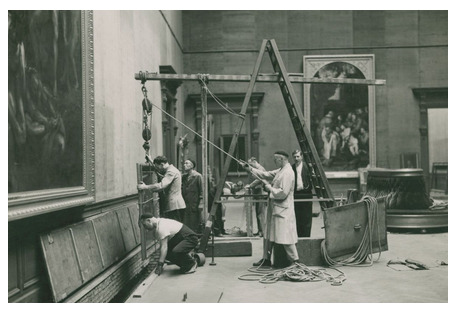
Staff at the KMSKA use the museum’s lifting system to lower artworks into reinforced basement storage for protection during wartime.
Before the Damage is Done: Emergency Storage and Civil-Military Cooperation in the Netherlands, France and Belgium from the Second World War to the Present – A Comparative Analysis
What happens to museums, monuments and collections when war threatens? This thesis compares how the Netherlands, France and Belgium have prepared for the protection of cultural heritage from the Second World War to the present. It focuses on emergency storage and civil-military cooperation, examining how wartime experience, changing threats and national structures shape the measures taken before a crisis to safeguard heritage.
War threatens not only people and infrastructure, but also cultural heritage. This thesis examines how the Netherlands, France and Belgium have protected cultural heritage from the Second World War to the present, focusing on two forms of preparedness: emergency storage for movable heritage and cooperation between civilian heritage actors and the military.
Through a comparative analysis, the study traces how these systems developed during the Second World War, the Cold War and the contemporary period. It explores how wartime experience, changing threat perceptions, national administrative structures and international frameworks have shaped the practical protection of heritage.
The comparison shows that shared international principles are translated differently in each national context. It also highlights that effective preparedness depends on more than plans on paper: clear responsibilities, up-to-date information, suitable storage options, training and functioning cooperation structures need to be in place before a crisis begins.
By placing current concerns in a longer historical perspective, the thesis addresses a question that has become increasingly urgent since Russia’s full-scale invasion of Ukraine: how can cultural heritage be prepared for conflict before it is too late?